Explore potential truck finance scenarios with our Truck Loan Calculator. Test different loan amounts, interest rates and repayment terms to estimate borrowing costs and see how different financing assumptions may affect repayments for Australian businesses and drivers.
Calculator results are estimates only and not quotes. Actual quotes will be provided by licensed brokers after you submit an enquiry.
Truck Loan Details:
Important!
Truck Loan Interest Rates differ from lender to lender and will depend on your individual circumstances (credit history, employment status, age, etc.). To find out if you qualify ... and for a free, personalised interest rate and repayment quote, please CLICK HERE
Truck Loan Amortisation Calculator
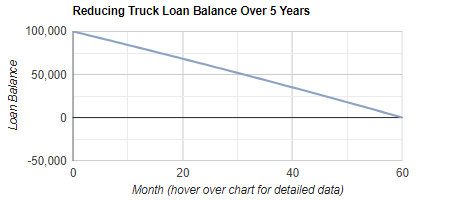
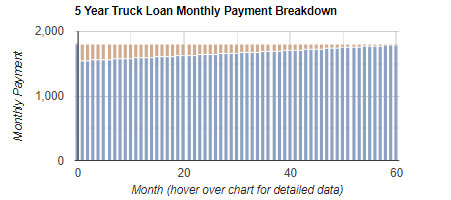
The following amortisation graphs detail month-by-month data on the progress of the proposed loan. The first chart below examines the reducing loan balance over the course of the finance contract term. The second graph illustrates the portion of each monthly repayment allocated to payment of interest vs principal reduction.
How to use our Truck Loan Repayment Calculator
Our Truck Loan Repayment Calculator helps Australian drivers and businesses estimate loan repayments before you commit. It is designed to support budgeting, cash flow planning, and comparing truck finance scenarios by showing how changes to price, deposit, term, and interest rate can affect your repayments and total interest cost.
How to complete the calculator for the most accurate estimate
1. Purchase Price
Enter the total purchase price of the truck you plan to finance. Consider including eligible on-road and purchase-related costs that may be financed (for example registration, insurance, or other costs where applicable). Use whole numbers only, without commas or decimals.
2. Deposit or Trade-in Value
If you are paying an upfront deposit or using a trade-in, enter that amount here. This reduces the amount you need to borrow and can lower repayments and total interest. Use whole numbers only.
3. Term of Loan (Years)
Select the loan term in years. In general, a longer term can reduce the periodic repayment but may increase the total interest paid over the life of the loan. Choose a term that suits your expected truck usage and business cash flow.
4. Interest Rate (Percent per annum)
Select an interest rate to model your scenario. Rates vary by lender and borrower circumstances, so it can be helpful to test a conservative rate as well as an optimistic one.
5. Calculate
Select calculate to generate your repayment estimate and repayment breakdown visuals.
How to interpret your results
1. Repayment estimate
Use this as a guide to affordability and budgeting. If the repayment is tight, test a higher deposit, shorter term, or different interest rate.
2. Amortisation and graphs
Review how the loan balance reduces over time, and how each repayment typically shifts from mostly interest early on to more principal later. This can help with planning for refinancing, early payout, or upgrade timing.
ASIC compliance note: This calculator provides information only and is not financial or credit advice. Results are estimates and may not include all fees, charges, taxes, residuals or balloon payments. Consider your objectives and financial situation, and seek independent advice or a lender quote before proceeding.
The National Heavy Vehicle Regulator’s 16 November 2026 warning to put safety ahead of freight deadlines is more than a seasonal road-safety message. For transport operators, the Black Friday and pre-Christmas delivery rush is also a live risk-management test, with driver fatigue, vehicle checks, scheduling pressure and Chain of Responsibility duties all capable of influencing claims, liability exposure and future truck insurance discussions. - read more
TruckSafe’s launch of its updated Safety Management System in Canberra on 10 November 2026 is more than an industry anniversary event. For transport operators, it is another sign that documented safety management is becoming central to how heavy vehicle businesses prove they understand and control risk, including when they discuss truck insurance renewals, claims history and fleet performance. - read more
Fresh commercial insurance data points to a more buyer-friendly market, but Australian truck operators should be careful not to read the headline fall as a simple forecast for cheaper heavy vehicle cover. Marsh’s Q3 2026 Global Insurance Market Index, released on 21 October 2026, reported a 12 per cent fall in Pacific commercial insurance rates for the quarter, led by property and supported by strong insurer competition. - read more
The latest National Truck Accident Research Centre major incident findings give transport operators a cautiously positive signal: large heavy vehicle loss numbers eased in 2025, but the underlying causes still point squarely to operational discipline. For businesses managing truck insurance, the practical takeaway is not simply that the road environment has improved. It is that insurers, brokers and fleet managers are likely to keep focusing on preventable risk, especially driver attention, speed, following distance and the quality of safety systems. - read more
Fresh insurance industry attention on severe weather preparation is a timely reminder for transport operators that storm, flood, hail and bushfire exposure is not just a seasonal inconvenience. For owner drivers, fleet managers and transport businesses, extreme weather can affect vehicle availability, freight commitments, depot safety, claims documentation and renewal pricing. - read more
Trucking accidents, while less frequent than passenger car incidents, carry significant repercussions due to the sheer size and logistics involved in commercial trucking operations. In Australia, the vast network of roadways that trucks navigate to deliver goods can often be the scene for a range of accidents. Rollovers, jackknifing, and collisions with other road occupants are comparatively common among these incidents. - read more
Owning a truck in Australia comes with its own set of responsibilities, and one of the most crucial of these is ensuring that you have the right insurance coverage. Truck insurance is not just a legal requirement but a safety net that protects your investment and livelihood against unforeseen events. - read more
When it comes to heavy haulage insurance in Australia, many operators are under the impression that the cheapest policy is the way to go. However, this approach overlooks the essence of insurance as a protective investment into your business's future. Skimping on coverage can lead to catastrophic financial consequences in the event of an incident, far outweighing any initial savings made on premiums. - read more
In Australia, trucking plays a vital role in keeping the economy on the move, often covering vast distances across the country. Therefore, securing the right truck insurance is not just a legal requirement but also a financial safeguard for operators and businesses. Truck insurance provides coverage for risks associated with operating commercial vehicles, protecting against damages, theft, and liability. - read more
Truck insurance does not always cover the freight being carried. This guide explains the difference between vehicle cover, goods in transit insurance and cargo cover, and what Australian truck operators should check before relying on a policy. - read more
Knowledgebase
Disability Insurance: A type of insurance protection that pays a portion of a person's income lost due to a total or partial disablement arising from either an accident or a sickness.